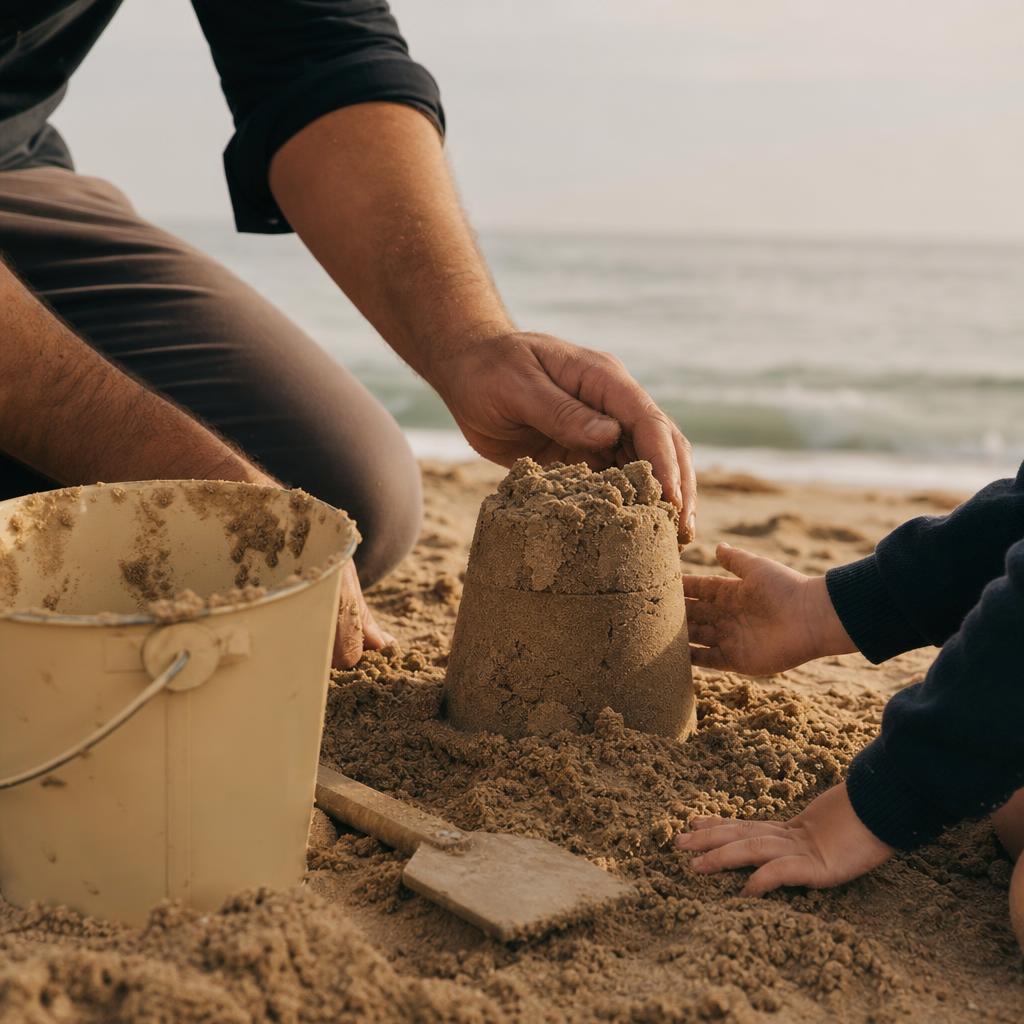
Picture this. It’s August. It’s hot in England, which is still unusual enough that we feel obliged to mention it. I’m on the beach with my three boys, buckets and spades everywhere, trying to build a sandcastle that is probably a bit too close to the sea.
At the same time, I find myself at something of a crossroads. Do I stay where I am, or do I finally start something of my own?
I’m not unhappy. Far from it. But for a long time I’ve had this fairly persistent desire to build something myself. After two decades working across brands, agencies, growth, digital, strategy, clients and teams, the idea has always been there somewhere in the background. What would I build if I could start with a blank sheet of paper? What would I keep? What would I leave behind? What would I do differently?
Being a beach person, and a surfer, I probably should not be surprised that the answer started to appear while I was sitting in the sand.
Because the more I thought about it, the more building a sandcastle felt like a pretty good metaphor for starting How Might We. Then I realised it was probably a pretty good metaphor for business in general.
The bucket is not the castle.
We tend to admire the finished castle. The towers, the moat, the detail, the flags. What we do not see is the messy bit that got it there. The sand that collapsed. The badly chosen patch of beach. The child who decided halfway through that the castle really needed a tunnel. The wave you knew was coming, but somehow hoped would not.
Businesses can be a bit like that too.
We often start with the bucket. A new platform. A new agency. A new campaign. A new process. A piece of technology. AI. Another dashboard. Another framework.
Tools matter, of course, but the bucket is not the castle.
Before any of that, you probably need to look at the tide. What is happening around you? What is changing in the market? What are customers doing differently? Where is demand moving? What are competitors doing? What is technology making possible that was not possible before?
You can build the most magnificent sandcastle on the beach, but if you completely ignore the conditions around it, the sea is not going to admire your strategy.
Then there is the question of where you build. Some patches of beach are perfect. Others look fine until you start digging and realise the sand is dry, loose and utterly useless. Context matters. Positioning matters. Capability matters. Timing matters.
Where you choose to build can be every bit as important as what you decide to build.
Then there is the sand itself. Too dry and it collapses. Too wet and it becomes a sloppy mess. You need the right mix.
For me, that feels a lot like the relationship between ambition and reality. Businesses need ambition. Without it there is not much reason to build anything interesting. But ambition has to meet evidence, customer understanding, capability and commercial reality somewhere along the way.
Too much reality and nothing ambitious ever gets attempted. Too much ambition without enough truth underneath it and the whole thing tends to slump as soon as you remove the bucket.
The foundations matter more than the decoration.
It is tempting to get to the visible stuff quickly. The campaign. The proposition. The new website. The shiny launch. The thing everyone can point at and say, “Look, we made that.”
But there is usually some compression required first. Getting clear on what you are trying to achieve. Understanding what is really going on. Agreeing what matters. Working out where the gaps are. Making decisions.
Decoration is great. I work in marketing, so I am hardly going to argue otherwise. But decoration sitting on weak foundations is still decoration sitting on weak foundations.
And then, inevitably, other people arrive. Someone wants a moat. Someone wants a second tower. Someone asks whether we should actually be building another castle over there as well.
Before long you have five half built castles, twelve buckets and a meeting about the bucket strategy. This is probably the point where the metaphor gets slightly too close to real life.
Focus matters.
Focus matters because momentum gets diluted remarkably quickly when everything is important. The more priorities you add, the less useful the word priority becomes.
Then something falls over. A turret collapses. A wall cracks. A wave takes out half the moat.
That is not necessarily failure. It is information.
Progress rarely comes from knowing exactly what to do from the beginning. It comes from getting better at figuring out what to do next. Build a bit. Step back. Look at what happened. Adjust. Strengthen the part that is weak. Knock something down if it is not working. Move if the conditions have changed.
There is a temptation in business to see changing direction as a sign that the original strategy was wrong. Sometimes it is. But sometimes the tide simply moved.
Sometimes the answer is to move the castle.
And when the tide moves, “build higher” is not always the smartest response. Sometimes the answer is to move the castle.
That might mean changing the proposition. Dropping a product. Choosing a different customer. Reallocating investment. Simplifying. Saying no. Doing less.
Eventually, of course, the sea wins. It always does. Markets move. Products mature. Competitive advantages disappear. Technology changes the rules. The thing that worked brilliantly for the last five years does not automatically earn the right to work for the next five.
Which is why perhaps the real capability was never owning the perfect castle. It was getting better at building.
Reading the conditions. Choosing where to play. Getting the foundations right. Using the right tools rather than all the tools. Bringing in the right people. Staying focused. Learning quickly. Knowing when to strengthen something and when to move.
Maybe, in some way, I’ve always been building a sandcastle. Maybe we all have.
Building something we care about. Watching parts of it get washed away. Learning what holds and what doesn’t, then having another go. The tides come and go. Circumstances change. Priorities shift. Sometimes what we build lasts for years. Sometimes it disappears overnight.
Perhaps the point was never to make any of it permanent. Maybe life isn’t one sandcastle. It’s a whole beach full of them.
And this is where the whole thing became rather personal for me.
Sitting there on the beach, I realised I had been thinking a lot about How Might We before it even had a name. The question in my head was really: how might I?
How might I turn what I had learned into something of my own? How might I work with ambitious organisations in a way that feels simpler, more useful and more human?
And, eventually, “How might I?” became “How Might We?”
Perhaps that is why starting a growth consultancy began to feel less like a dramatic leap and more like the logical next thing to build.
A way to work with ambitious organisations that want to grow, change direction, unlock something that has stalled, or sometimes simply benefit from an experienced pair of eyes from outside the business.
The mission is deliberately simple: to help ambitious organisations grow. With more clarity. More confidence. More momentum.
How Might We might be new. The craft behind it is not.
Maybe that is the other reason the sandcastle metaphor stuck. I have spent years seeing how things get built, rebuilt and occasionally swept away. Helping other organisations see their own castle more clearly feels like a logical next chapter.
I certainly do not think twenty years gives me all the answers.
But it does give me plenty to lean on while my clients and I work out the right questions.
That feels important.
Because the castle was never really the point.
Getting better at building was.
So, here we are. How Might We is born. A growth consultancy built to help ambitious organisations decide what matters, make better choices and turn intention into movement.
And, hopefully, build some pretty good sandcastles together along the way.
How Might We work together?